
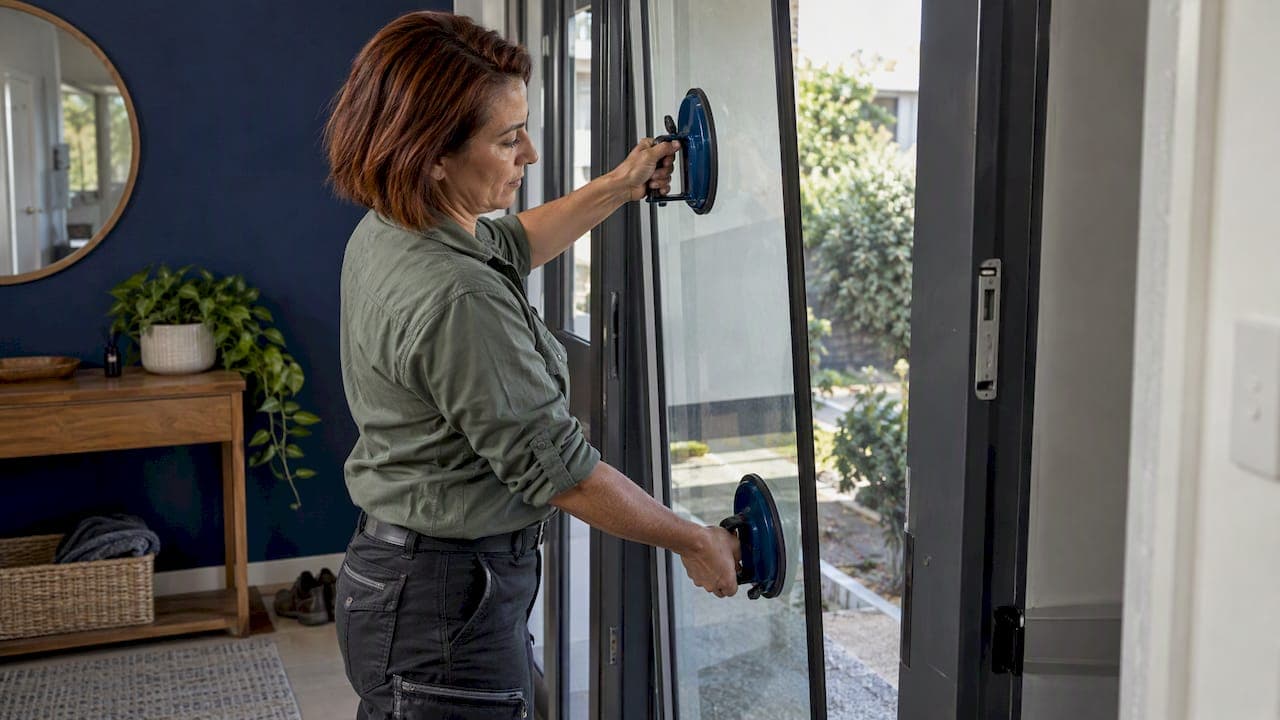
Yes, you can usually replace the glass in a door without replacing the door. If the frame is sound, a glazier removes the cracked or fogged glass, fits new correctly sized glass and reseals it. In New Zealand the replacement glass for a door must be safety glass, so the pane is made to size, not cut on site. This guide explains how to decide between replacing the glass and replacing the door, what glass to choose, what affects the price and what to ask before you book.
TL;DR
- Entry, French, sliding and bifold door glass can normally be replaced while the existing frame stays, provided the frame is straight, sound and suitable for the new glass.
- Doors need safety glass in New Zealand: laminated or toughened. Toughened glass is cut to size before heat treatment, so it has to be measured exactly and ordered.
- Cost depends on glass size, type, access, the door style and the call-out, not on glass alone. Ask for a written quote that separates glass, labour and any frame work.
- If the frame is worn, warped or leaking, new glass in an old frame is money poorly spent. A full or insert replacement may be the better choice.
- Replacing an exterior doorway in an existing home often needs no building consent, but there are exceptions.
Table of Contents
- Can you replace door glass without replacing the door?
- Repair, replace the glass, or replace the whole door?
- Which glass is allowed in a door in New Zealand?
- What affects the cost of door glass replacement?
- Do you need a building consent?
- Can you do it yourself?
- What to ask before you book
- Our perspective
- Need the glass or the whole door replaced?
- When retrofit double glazing is the smarter move
- FAQ
- Sources
Can you replace door glass without replacing the door?
In most cases, yes. The Window & Glass Association of New Zealand describes retrofit double glazing as replacing the existing glazing while keeping the existing window or door frames, and calls the process economical and usually non-invasive. The same principle applies when a pane is simply broken or damaged: the glass is the part that changes.
There are conditions. The frame and door must be suitable, and the new unit must be correctly sized, sealed and installed. That last point is where most problems start. A pane that is a few millimetres out, poorly blocked or sealed with the wrong compound will leak, rattle or fail early.
What this looks like on different doors
- Entry doors with glass panels or sidelights: the glass sits in a bead or glazing channel. It can be removed, the opening checked, and a new pane fitted. If you are choosing glass for a front door, our guide to glass for front entry doors in Auckland covers privacy, light and security.
- French doors: each leaf usually has one or more panes. A single cracked pane can be replaced without touching the leaf, though matching the look of the other panes matters if the glass is patterned or has glazing bars.
- Sliding doors: the panels are often large, which makes the glass heavy and the job awkward. Panels are lifted out of the track, reglazed and rehung. Large panes are not a casual two-person job.
- Bifold doors: each panel is smaller, but there are many of them, and the hardware must be left running smoothly after the work.
Repair, replace the glass, or replace the whole door?
This is the decision that saves or wastes the most money. Work through it in this order.
1. Look at the frame first
Press along the frame and check the corners. If the aluminium is sound and the door closes cleanly, the glass is the problem and the glass is what you replace. If you can see gaps at the corners, pitted or corroded metal, worn rollers, a sagging leaf or daylight round the edges, the frame is the problem. New glass in a tired frame will not fix a draught.
2. Work out what is actually wrong with the glass
| Problem | What it usually means | Typical answer |
|---|---|---|
| Cracked or shattered single pane | Impact, thermal stress or a flaw in the glass | Replace the pane with safety glass |
| Fogging or condensation between the panes | The seal on a double glazed unit has failed | Replace the sealed unit |
| Scratched or etched surface | Surface damage only | Often replaced if it affects the view or privacy |
| Rattling or loose glass | Failed sealant or beading | Reseal or reglaze, check the bead |
| Cold, draughty door | Single glazing, worn seals or an ageing frame | Retrofit double glazing, or full replacement if the frame is tired |
3. Think about the age of the door
If the door is 20 or more years old, ask whether you will be back in a few years for the hinges, rollers, locks or seals. A frame near the end of its life is a case for replacement. A frame in good condition is a case for reglazing.
4. Decide what you want the door to do
If the door is simply cracked, a like-for-like replacement may be all you need. If the room is cold, noisy or exposed to the western sun, this is the time to upgrade the glass specification. You are paying for glazing labour anyway.
If you want a view on our approach: we replace glass where the joinery is sound, and we say so plainly when the frame will not justify it. See the Perspective section below.
Which glass is allowed in a door in New Zealand?
Safety glass is mandatory for glass doors. Windows & Glass NZ states that safety glass is required in areas at high risk of human impact, including doors and larger windows. Two types are used:
- Laminated glass has a plastic interlayer that holds the shards in place when the glass breaks. It also helps with noise and UV.
- Toughened glass is heat-treated. When it breaks it fractures into small chunks rather than sharp shards.
MBIE explains that safety glass is commonly required in locations including doors under Building Code Clause F2, and that safety glazing should carry permanent markings identifying the material and the applicable standard. If the markings are missing, other proof such as product certification is needed. In practice, this means you should look for the etched mark in the corner of the new pane once the job is done, and keep the paperwork.
Why measuring matters
Toughened glass has to be measured and cut to size before the toughening process, and it cannot be recut or reworked after heat treatment. A pane that arrives 3 mm too large cannot be trimmed on site. That is why a proper glazier measures the opening, allows for the clearances and ordering lead time, and does not guess from a photo.
Going beyond like-for-like
The government's Building Performance site lists extra glass options in New Zealand, including low-E glass for energy efficiency, tinted or reflective glass for heat and light control, and laminated glass for noise and UV protection. For a door, the common upgrades are:
- Double glazed safety units to cut heat loss and condensation. Our guide to double glazing for doors explains how this works in an Auckland home.
- Low-E coatings if the door faces the sun or loses heat to a cold room.
- Laminated glass if you live near a main road, or want extra resistance to forced entry at a front door.
- Frosted or patterned glass where you want light but privacy, such as a bathroom or an entry beside the street.
What affects the cost of door glass replacement?
We do not publish fixed prices for this work, and no honest quote can come from the keyword alone. Door glass is priced by the job. The main factors are:
- Size of the pane. Price rises with area, and large sliding door panels cost much more than a small entry door light.
- Type of glass. Laminated, toughened, double glazed, low-E and acoustic glass are all priced differently.
- Single pane or sealed unit. A double glazed unit costs more than a single pane, but it also does more.
- Door style and access. A ground floor door with easy access is simpler than an upper floor door or a door with fixed glazing bars and beads.
- Frame condition. New beads, seals, rollers or hardware add to the job.
- Call-out and travel. Getting a tradesperson on site is a real part of a small job's cost, so it makes sense to bundle other small jobs into one visit, such as a sticking window or a worn seal.
- Lead time. Made-to-measure glass is ordered, not pulled from a shelf.
Be cautious with online price lists. Many are old, quote glass only without labour or GST, or assume a different glass type. Ask for a written quote that breaks out the glass, labour, any frame work and GST, and says exactly which glass will be fitted.
If you are considering a bigger upgrade, see our guide to double glazed window costs in Auckland for how pricing works across a house.
Do you need a building consent?
Usually not for a like-for-like job. MBIE's guidance says that replacing an exterior doorway in an existing dwelling of no more than two storeys usually needs no building consent, unless the doorway failed durability requirements or the work affects a specified system. The age of the door and the reason it failed can matter, even when the replacement looks like for like.
If your door is young and has already failed, or the work involves altering the opening, check with your council before you start. For the wider picture, our article on building code compliance for NZ windows and doors sets out what applies.
Can you do it yourself?
On a small, low-risk pane some people try, but door glass is not a typical DIY job. Safety glass is heavy and the edges can injure you. A pane has to be measured to the millimetre, blocked correctly and sealed with compatible sealants. The industry guidance says insulating glass units must be correctly sized, blocked and beaded into the opening, with sealants compatible with the surrounding materials. Get it wrong and you have leaks, stress cracks or a pane that can fall out of the frame.

If the glass is broken right now, keep people and pets away, tape or board the opening to keep it secure and weathertight, and wear thick gloves if you are clearing fragments. Then call a specialist.
What to ask before you book
- Is the frame suitable for reglazing? A good installer inspects it rather than assuming.
- Which glass will be fitted? It should be laminated or toughened safety glass, with permanent markings.
- Is the quote itemised? Glass, labour, frame work and GST should be clear.
- Who measures? The person fitting the glass should measure it.
- How long will it take? Ask about the lead time for made-to-measure glass and whether the opening will be secured meanwhile.
- What is guaranteed? Ask for the warranty in writing and what it covers.
Our perspective
We only work with aluminium joinery, and that shapes how we look at a door with a broken or tired pane. The first question is never "what can we sell you?" but "what is the frame doing?" If the aluminium is straight and sound, reglazing is a sensible way to get a better door without the cost of replacing it.
What we see across Auckland is that the glass is rarely the whole story. Doors in older homes often have worn seals, tired rollers and single glazing that makes the room cold. A pane replaced on its own fixes the crack. A pane replaced with a considered specification, and a frame that is checked and adjusted at the same time, fixes the door.
When the frame has reached the end of its life, we would rather tell you that early. Our full replacement and insert options let us fit a thermally broken aluminium door that suits your home, installed with precision and backed by our five-year workmanship warranty.
Sharim
Need the glass or the whole door replaced?
We supply and install premium aluminium windows and doors across Greater Auckland, including entry doors, French doors, sliding doors and bifold doors. If your door needs repairs or a new pane, our aluminium window and door repairs team can assess the frame and tell you plainly which option makes sense.

If the frame is worn out, a full replacement or insert fits new joinery into your existing structure with minimal disruption. Visit Auckland Window and Door Services to request a quote.
When retrofit double glazing is the smarter move
If your door glass is single glazed and the aluminium frame is sound, replacing a broken pane is a chance to upgrade. Retrofit double glazing swaps the glazing and keeps the frame, which is the approach the industry guidance describes as economical and usually non-invasive. Our guides to retrofit double glazing in Auckland and aluminium double glazing walk through the process and what to expect.
Two cautions apply. Older frames are sometimes too shallow to take a thicker double glazed unit, and the frame must be in good enough condition to justify the investment. A site visit settles both questions in a few minutes.
For a wider look at your home, retrofit window replacement covers how reglazing and insert replacement compare, and window repair covers the small fixes that keep joinery working.
Character homes and special glass
If your home is older, the door may have leadlight, patterned or bevelled glass you want to keep the look of. Matching it takes care, and it is worth reading our historic home window replacement guide before you commit to a like-for-like swap.

Commercial doors
Shopfront and office doors take far more use than a house door, and the glazing rules and hardware demands differ. If you manage a commercial property, our commercial doors and shopfronts service covers glazing and frames built for heavy traffic.
FAQ
Can entry door glass be replaced?
Yes. If the door and frame are in good condition, the glass can be removed and a new pane fitted without replacing the door. The pane must be safety glass, accurately measured and sealed properly. A specialist should inspect the frame first to confirm it is worth reglazing.
Do I need safety glass in a door?
Yes. In New Zealand, safety glass is required in doors because of the risk of human impact. Laminated and toughened glass are the two common types. The glass should carry permanent markings identifying the type and standard, so check for them after installation.
Is it cheaper to replace the glass or the whole door?
Replacing glass alone is usually the lower-cost option when the frame is sound, because the door, hardware and finish stay in place. If the frame is worn, warped or leaking, new glass will not fix those problems and replacing the door may be better value over time. The right answer depends on the frame, so get it inspected.
Can I replace door glass with double glazing?
Often, yes. Retrofit double glazing replaces the existing glazing and keeps the existing frame. The frame has to be deep and sound enough for the new unit. Your installer should confirm this when they measure.
Do I need a building consent to replace door glass?
Usually not for a like-for-like replacement in an existing home of no more than two storeys. Exceptions apply if the doorway failed durability requirements or the work affects a specified system, so check with your council if you are unsure.
Sources
- Window & Glass Association of NZ: Retrofit double glazing Industry Best Practice (2023)
- Windows & Glass NZ: Choosing glass guide
- Building Performance: Making sure you have safety glass?
- Building Performance: Glazing and glass options
- Building Performance: Windows and exterior doorways in existing dwellings and outbuildings