
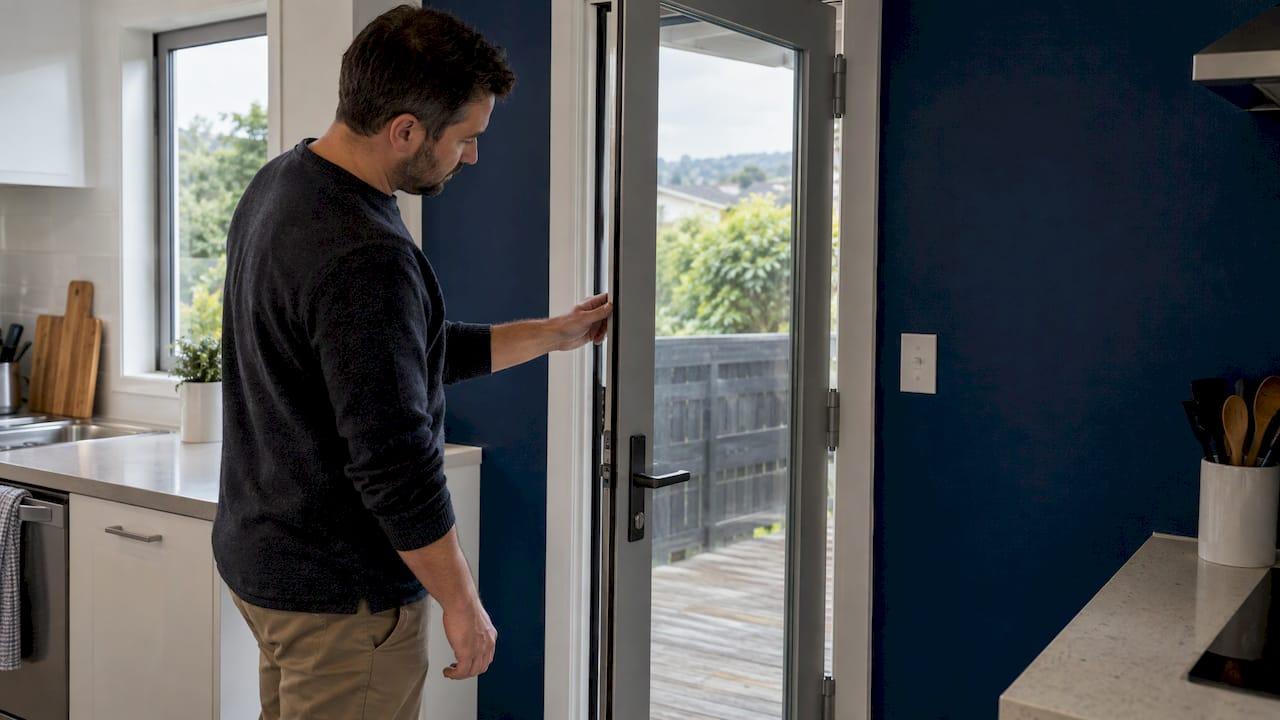
A door that won't close is almost always one of five things: loose or worn hinges, a latch and strike plate that no longer line up, swollen timber, a dirty or worn roller on a sliding door, or a frame that has moved. Work through them in that order and you will usually find the culprit in ten minutes. If several doors in the house are misbehaving at once, the door itself is probably not the problem.
This guide shows you how to tell the causes apart, what to try first, and when the sensible move is to bring in a joiner or a specialist who works with aluminium joinery every day.
TL;DR
- Check the hinges first. A door that rubs at the top or won't latch is usually sagging because the top hinge screws have loosened.
- If the bolt hits the strike plate instead of entering it, the latch is the issue, not the door. Chalk the bolt to see where it lands.
- Timber swells in humid weather, so a door that sticks in winter and frees up in summer may need drying out, not planing.
- Sliding aluminium doors that won't shut usually need clean, free-running tracks and rollers, or worn rollers replaced.
- Several sticking doors, cracks or sloping floors can point to ground movement. Call a foundation specialist before you touch the doors.
Table of Contents
- Start by working out where the door is catching
- Loose or sagging hinges
- Latch and strike plate problems
- Swollen timber and humidity
- A door that swings open or shut by itself
- Sliding doors that won't close or latch
- Door closers and exit hardware
- When it's not the door: frame movement
- Perspective: what we see on Auckland jobs
- Getting it fixed properly in Auckland
- A simple order of checks
- FAQ
- Sources
Start by working out where the door is catching
Before you pick up a screwdriver, close the door slowly and watch. Where it touches tells you what is wrong.
| What you see | Likely cause | First thing to try |
|---|---|---|
| Rubs or jams at the top corner on the handle side | Sagging door, loose top hinge | Tighten top hinge screws |
| Bolt hits the frame beside the strike plate | Latch and strike out of line | Adjust or reposition the strike |
| Door sticks along the edge, mostly in wet weather | Swollen timber | Dry the room, then plane if needed |
| Door swings open or shut on its own | Door not plumb, hinges loose | Tighten hinges, then adjust a hinge pin |
| Sliding door stops short or drags | Dirty track, worn rollers | Clean and lubricate, then check rollers |
| Several doors and windows stick together | Frame movement or settlement | Get a specialist to look at the building |
Consumer NZ lists the common reasons doors stick: moisture or thermal expansion, handles or locks that need adjusting, paint build-up, dry or corroded hinges, and the frame moving as a house settles. That list is a handy checklist to run through.
Loose or sagging hinges
The top hinge carries most of a door's weight, which is why its screws are the first to work loose. The Spruce explains that screws in the top hinge wear out and start to pull out in a way the bottom hinge's screws don't. A heavy door hung on only two hinges makes this more likely.
A sagging door typically shows up as a rub or catch along the top edge on the latch side, or a gap down the hinge side.
- Open the door and tighten every screw in the top hinge, on both the door leaf and the frame side. Don't overtighten.
- Use a hand screwdriver rather than a drill. Consumer NZ advises this for top hinge screws, because a drill can strip the hole.
- If a screw just spins, the hole is stripped. Swap in a longer screw that bites into the stud behind the frame, or plug the hole with a dowel or matchsticks and PVA glue, let it dry, then drive the screw back in.
- Check the hinge pins. Replace any that are worn or missing, and lubricate with a penetrating oil or graphite powder.
Dry or corroded hinges also stop a door from closing smoothly. If the hinges look tired, replacing them is quicker than coaxing them along.
Hinges on aluminium windows and doors
Aluminium joinery uses purpose-made hinges and stays, and they are not the same as the brass butt hinges on an internal timber door. If a casement sash or an aluminium hinged door has started to bind, drop or refuse to latch, our guide to aluminium window hinge replacement explains what wears and what a replacement involves.
Latch and strike plate problems
If the door sits flush but the latch won't catch, the bolt and the strike are not meeting. Don't start filing yet. Find out where they miss.

Schlage's advice is to mark the bolt with chalk or lipstick, turn the lock a few times, then look for the smear on the strike. That shows where the bolt is rubbing. If material is blocking the bolt hole, a chisel will clear it. Schlage also notes that weather stripping that is too thick can stop the bolt from extending, and the bolt pocket needs to be deep enough for the bolt to go all the way in.
A few practical points:
- A small miss can be fixed by carefully filing the strike opening. A bigger miss means moving the strike plate.
- When you move a plate, plug the old screw holes with dowel, drill fresh pilot holes in the right spot, and test the door several times.
- Treat strike changes as the last step. The Steel Door Institute's troubleshooting guide says to check door sag, hinge bind and twisted frames first, because a hardware-only change can hide an alignment problem that will come back.
For aluminium window latches and locks, which have their own mechanisms, see our homeowner's guide to aluminium window latches.
Swollen timber and humidity
Auckland is humid, and timber doors take up moisture. A door that binds in a wet winter and loosens in a dry spell is a classic sign. Teknos reports that timber dimensions change by roughly 1% for every 3% change in moisture content, though the exact figure depends on species and grade. That is enough to turn a snug door into a tight one.
What to do, in order:
- Ventilate the room and run a dehumidifier or heat pump for a few days. Consumer NZ's first recommendation is to let the door dry.
- If it still sticks, find the exact spot (a strip of paper or a pencil mark helps) and plane that edge, then re-hang.
- Seal any bare timber you expose, including the top and bottom edges, so it doesn't soak up moisture again.
Paint build-up on edges and in rebates can also add enough thickness to make a door bind. If the paint is thick and glossy where the door meets the frame, that may be all it is.
A door that swings open or shut by itself
A door that drifts is not plumb. The frame may have been hung slightly out of true, it may have settled, or the hinges may have loosened. Family Handyman suggests tightening the hinge screws first. If it still moves, take out the middle hinge pin, bend it very slightly over a hard flat surface, put it back and test. You can repeat the step on the lower hinge if needed.
The bend adds a little friction and cures minor drifting without taking the door off. If bending the pins doesn't help, the door and frame need rehanging, which is a job for a joiner.
Sliding doors that won't close or latch
Sliding doors fail for different reasons than hinged doors. The usual suspects are grit and hair in the track, dried-out or worn rollers, and a door that has dropped on its rollers so it drags.
Consumer NZ's advice for sliding doors is to clean and lubricate the rollers, repair or replace damaged ones, and adjust roller height if needed. In practice:
- Vacuum the track, then wipe it clean. Debris builds up fast near coastal and building sites.
- Check that the drain slots in the track are clear, so water doesn't sit in the channel.
- Lift and wiggle the door slightly. If it feels rough or one corner sits low, the rollers are worn or need adjusting.
- If the lock won't line up with its keeper, the door is probably sitting low. Fix the roller height before touching the lock.
For more on tracks, our Auckland homeowner's guide to sliding door tracks covers what wears and why. If your track is bent, pitted or the rollers are beyond saving, aluminium door repairs are usually a faster and tidier answer than another round of lubricant.
Door closers and exit hardware
On a door with a closer, such as a commercial entrance or a heavy external door, a door that stops closing is often telling you about the hinges. Allegion's New Zealand maintenance guidance says that if you keep having to turn the closing speed or force up, the hinges may be worn, letting the door sag and bind and straining the closer. The same guidance says closers should be maintained at twelve-monthly intervals, with all fixing screws checked and tightened, and that door seals or other hardware stopping the door from closing should be examined.

For shopfronts and busy entrances, that yearly check is cheap insurance. Heavy daily use or a coastal setting calls for more frequent attention.
When it's not the door: frame movement
If you have tightened, adjusted and dried out and the door still won't close, look at the building.
Mainmark, a New Zealand ground-engineering company, warns that several doors sticking, scraping or jamming can signal ground movement, settlement or subsidence that has twisted or dropped door frames. Wall cracks, gaps, sloping floors and sinking concrete add weight to that suspicion.
The practical line is simple:
- One door sticking: a builder or joiner can usually adjust it.
- Several doors or windows jamming, or cracks and uneven floors: speak to a foundation specialist before spending money on the doors. Mainmark says fixing only the door may not solve the problem if movement is continuing.
A garage door has its own failure modes. If yours is the one that won't close, damaged panels can be the cause, and this piece on garage door dent repair helps you decide between fixing and replacing a panel.
Perspective: what we see on Auckland jobs
We work only with aluminium joinery, so we see the same pattern again and again. A door that won't close is rarely a mystery. It's usually a hinge that has given up, a roller that has worn, or a frame that was never installed square.
Our view is that the cheapest repair is the one done early. A sagging aluminium door left alone wears its hinges and locks faster, and the fix grows from a small adjustment to a part replacement. That is why we like to look at the whole opening, not just the part that is rubbing.
Sometimes the honest answer is that the unit has reached the end of its life. A drafty, tired frame that keeps needing adjustment is a good candidate for an insert or full replacement, with a modern thermally broken or double-glazed unit designed to cope with Auckland's climate. When we do the work, precise installation is the point: the door should close with a light push and stay that way, and our workmanship is backed by a five-year warranty.
Sharim
Getting it fixed properly in Auckland
If your aluminium door or window has dropped, jams, or won't latch, we repair and, where it makes sense, replace them across Greater Auckland. Our aluminium window and door repairs cover hinges, rollers, locks and tracks, and we can tell you quickly whether a repair will last or whether a new unit is the better answer.

Where the whole opening is tired, our insert and full replacement service fits modern aluminium joinery into your existing home. For a new entrance, see our entry doors, or read our door installation guide to see what the process looks like. Commercial owners with a shopfront that won't shut can start with commercial doors and shopfronts.
A simple order of checks
If you want one routine to follow, this is it:
- Close the door slowly and note where it touches.
- Tighten the hinge screws, top hinge first.
- Check the hinge pins and the condition of the hinges.
- Chalk the latch bolt and see where it lands on the strike.
- Look for swelling, paint build-up or damp, and dry the room.
- On sliders, clean the track and check the rollers.
- Look around the house for cracks, sloping floors and other sticking doors.
- If you've done the above and the door still binds, call someone.
The order matters. Hinges fix more doors than any other single step, strike changes should come last, and anything pointing to ground movement deserves an expert before any cosmetic fix.
FAQ
Why won't my door close all the way?
The most common reasons are a sagging door from loose top hinge screws, a latch bolt that misses the strike plate, or swollen timber. Watch where the door touches the frame. That spot points to the cause, and the hinges are the first place to check.
Why is my door sticking at the top?
Sticking at the top usually means the door has dropped on its hinge side, so the top corner meets the frame. Tighten the screws in the top hinge, and if they spin freely, use longer screws that reach the stud or plug the holes first. If the whole frame seems to have dropped, it may be settlement.
Why does my door swing open by itself?
The door is not hanging plumb, either because the frame is slightly out of true or the hinges have loosened. Tighten the hinge screws, then try a slight bend in the middle hinge pin. If that doesn't work, the door needs rehanging.
Why does my sliding door not close properly?
The track is usually dirty or the rollers are worn or set too low. Clean the track, lubricate the rollers and check their height. If the rollers are damaged or the track is bent, a repair or part replacement is the lasting fix.
When should I call a professional?
Call someone when one door still binds after the basic checks, or when a frame needs rehanging. If several doors and windows stick, or you see cracks, gaps or sloping floors, speak to a foundation specialist first.
Sources
- Windows and doors, Consumer NZ
- Door Hardware Maintenance, Allegion New Zealand
- Jammed Doors and Sticking Windows, Mainmark
- How to Fix a Sagging Door, The Spruce
- How to fix a door that won't latch, Schlage
- Installation Troubleshooting Guide for Standard Steel Doors and Frames, Steel Door Institute
- Winter Painting, Teknos
- How to Stop a Door From Swinging Open, Family Handyman
- Garage Door Dent Repair: Fix It or Replace the Panel?