
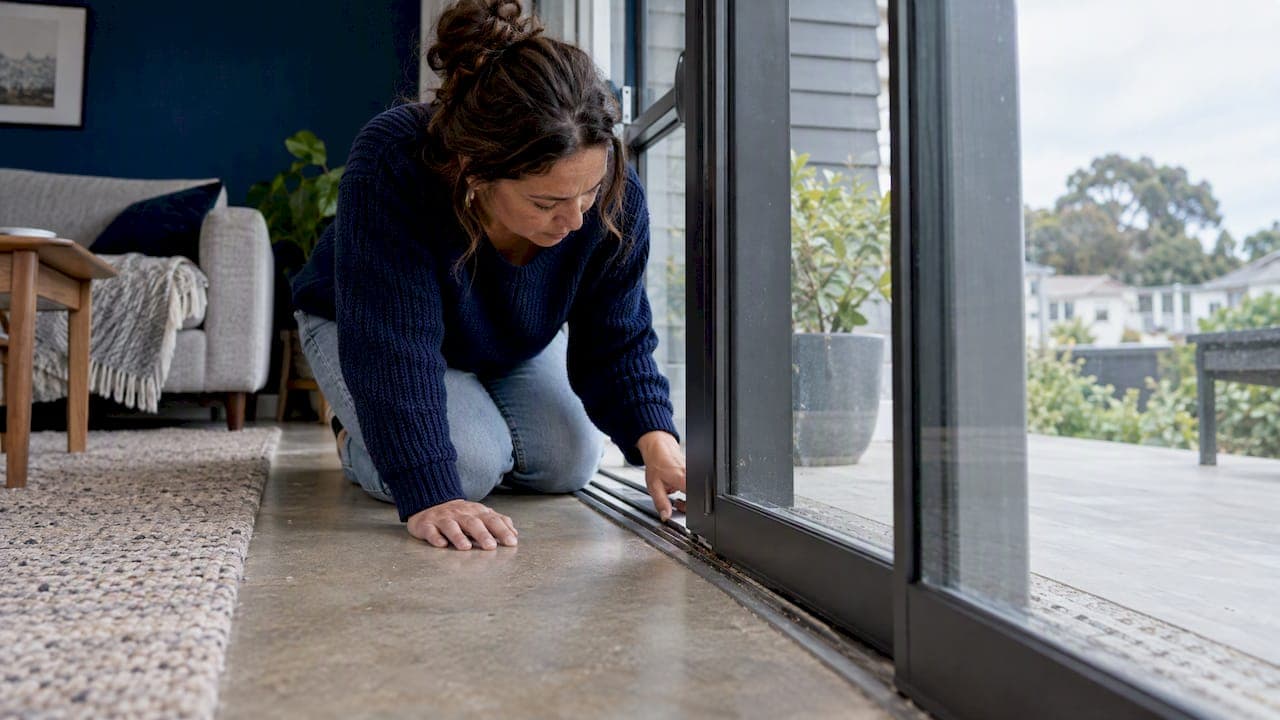
A sliding door that sticks is almost always one of three things: a dirty or damaged track, worn or misadjusted rollers, or a lock and keeper that no longer line up. Most of the time a clean, a suitable lubricant and a small roller adjustment bring it back to smooth running. If the panel is unstable, scrapes the frame or threatens to leave the track, stop and get a specialist in.
This guide shows you how to tell which problem you have, what to do about it, which lubricants suit aluminium, and where the DIY line sits. It also covers windows that are hard to open, because the causes overlap.
TL;DR
- Clean the track first. Dirt, grit and small stones are the most common reason a door drags, and it costs you nothing to rule out.
- Lubricate with silicone spray or a dry PTFE product on rollers and a little wax on the track. Avoid heavy oils that collect grime.
- If the door still rubs, the rollers probably need adjusting or replacing. Adjust a little at a time and test after each turn.
- Never lift out or adjust a large glass panel alone. Sliding doors are heavy and can fall.
- A twisted sash, bent track, damaged frame or sagging lintel is a job for a professional, not a bigger hammer.
Table of Contents
- Work out what is causing the sticking
- Before you start: keep it safe
- Step 1: Clean the track properly
- Step 2: Clean and lubricate the rollers and track
- Step 3: Adjust or replace the rollers
- When the track, frame or lock is the problem
- Windows that are hard to open
- A simple maintenance routine
- When to stop and call a specialist
- Our view on sticking sliding doors
- Get your sliding door working properly again
- FAQ
- Sources
Work out what is causing the sticking
Before you reach for a spray can, spend two minutes watching how the door behaves. The pattern of the problem points to the cause.
| What you notice | Likely cause | First move |
|---|---|---|
| Heavy and gritty along the whole run | Dirty track or worn, dirty rollers | Vacuum and wipe the track, clean the rollers |
| Catches at the same spot every time | Dent or raised edge in the track, compacted debris, or something rubbing | Inspect that section of track closely |
| Scraping, rocking, or one end sits low | Rollers out of adjustment or worn | Check roller height and the gap along the frame |
| Slides smoothly but won't lock or latch | Lock and keeper out of line | Check the keeper position and the lock mechanism |
| Door suddenly won't move at all | Jammed track, or the lock is partly engaged | Push towards closed while unlocking, then check the track |
This is a practical way to sort faults, not a formal test. Consumer NZ, in its guidance on maintaining windows and doors, lists the same trio for a sticking or jamming door: dirt, lack of lubrication or misalignment.
One quirk catches people out. Some sliding door locks have a passive feature that holds the door when it looks unlocked. Try pushing the door gently towards the closed position while you turn the lock open. It sounds too simple, but it frees a surprising number of "stuck" doors.
Before you start: keep it safe
Sliding glass panels are heavy. This Old House advises having a second person to help whenever you remove or refit a door, and wearing safety glasses and gloves. Its guide to adjusting a sliding door recommends at least two people when you adjust a top track, because a glass panel can tilt out.
For most of what follows (cleaning, lubricating, small roller adjustments) you can work with the panel in place. Panel removal is the step where you should have help, or hand the job over.
A few other habits help:
- Lay a drop cloth or old towel under the track to catch debris and spray.
- Keep children and pets clear of the opening while a panel is loose.
- Stop if the panel feels like it could come off the track. That is the moment to call someone, not to push on.
Step 1: Clean the track properly
A dirty track is the most common cause and the easiest fix, so start here every time.
- Open the door fully and vacuum the loose material from the bottom track. A narrow crevice nozzle gets into the corners.
- Pick out anything stubborn: small stones, bits of gravel, dead insects, caked dust. An old toothbrush or a wooden skewer works well.
- Wipe the track with a damp cloth and a mild detergent, then dry it. Wet tracks collect grit again quickly.
- Check the weep holes and drainage slots in the track. If they are blocked, water sits in the track and dirt turns to paste. Consumer NZ suggests using washing time to look for blocked drain outlets, along with chalking, condensation, mould and corroded fixings.
- Look at the top track too, if you can see it. Dust and cobwebs there add drag.
- Retest. Slide the door slowly end to end and feel for any spot that catches.
Houses near the coast, on unsealed driveways or beside gardens tend to bring more grit and salt to the track, so the track may need attention more often than the standard "every few months". If your door faces prevailing wind, check it after dry, gusty spells.
Cleaning the track is also where a lot of homeowners find out how much of the grime is baked on. If the glass, frames and tracks across the whole house are overdue, a professional window cleaning service that includes track cleaning can save you an afternoon, and it makes every later check easier.
Step 2: Clean and lubricate the rollers and track
Once the track is clean, the rollers are next. This Old House names dirty rollers as a principal cause of stuck doors. Its approach is to clean the wheels with denatured alcohol, lubricate them with silicone spray and run paraffin wax along the bottom track.
You can often reach the rollers by sliding the door to one end and looking at the bottom edge, or by lifting the panel slightly if the design allows. If you cannot see them without taking the panel out, leave that for the two-person step below.
Which lubricant is right
The aim is a thin, dry-ish film that reduces friction without attracting dust. Thick grease and general oils tend to collect grit, which is how a one-off fix turns into a sticky track again in a month.
- Silicone spray on rollers and on the track edges is a common choice. AutoSlide's support guidance, written for automatic sliding door operators, recommends silicone or aluminium lubricant rather than WD-40 on tracks and rollers.
- Paraffin wax rubbed on the bottom track gives a slick, non-sticky surface.
- Dry PTFE lubricant: WD-40 New Zealand lists its Anti-Friction Dry PTFE Lubricant as safe for metal, glass and plastic, which suits a door that combines all three.
Can you use WD-40 on an aluminium sliding door?
According to WD-40 New Zealand, its Multi-Use Product may be used on aluminium doors and windows. It adds two sensible conditions: test painted or powder-coated surfaces in a hidden spot first, and contact the window or door manufacturer so you do not affect the warranty. If your door is new or under a workmanship warranty, make that call before you spray.
The practical point: a multi-use spray can free a seized roller in a hurry, but for lasting smooth running a silicone or dry PTFE product is the better habit, and wipe off any excess so it does not trap dust.
How to apply it
- Wipe the rollers and track so you are not lubricating dirt.
- Apply the lubricant sparingly to the roller wheels and axles, and to the track edges the rollers run on.
- Slide the door back and forth several times to spread it.
- Wipe away overspray from the glass, the floor and any seals.
If the door is noticeably easier, you have found your fault. If it only improves briefly, the rollers are probably worn, or the door is out of adjustment.
Step 3: Adjust or replace the rollers
Most sliding doors have adjustment screws at the bottom of each panel, often behind small caps at the edge or on the face. Turning them raises or lowers that side of the panel on its rollers. Consumer NZ says that if a door will not shut properly, you should clean and lubricate the rollers, repair or replace damaged ones and adjust their height if needed.
A careful method:
- Check the door is level and plumb. Look at the gap between the panel and the frame at the top, bottom and sides. It should be even.
- Locate the adjustment screws on the bottom of the panel.
- Raise or lower both sides equally. AutoSlide's guidance is to lift both sides the same amount when using the height screws, so the panel does not twist.
- Make small adjustments, a quarter turn or so at a time, and test the door after each one, as This Old House's adjustment guide suggests.
- Stop when the gaps look consistent and the door runs freely without lifting off the track or dragging on the bottom.
If the rollers are visibly flat-spotted, cracked, rusted or no longer turn, adjustment will not fix them. Replacement rollers need to match your door's make and profile, and getting the wrong ones is a common DIY snag. The roller type, wheel size and fixing method vary from system to system, so take the old roller with you, or have a specialist identify it.
If you want more detail on the track itself, our guide to sliding door tracks for Auckland homeowners goes through how they wear and what to look for.
When the track, frame or lock is the problem
Bent or damaged track
If the door catches at the same place every time even after cleaning, run a fingertip along the track (with the door out of the way) and look for dents, raised edges or distortion. A small burr can sometimes be eased, but a bent aluminium track generally needs repair or replacement, because a flattened or crushed section keeps chewing up rollers. This is where a repair visit is worth more than another can of spray.

Lock and keeper misalignment
If the door glides well but is hard to latch or unlock, the issue is the lock and keeper. Check that the keeper on the frame lines up with the lock hook, and that nothing is stopping the lock from retracting fully. Over time, small changes in panel height from roller wear can drop the lock out of line, so fix the rollers first and then recheck the lock.
Door that has dropped or a frame that has moved
If the gaps around the door are visibly uneven even after you have adjusted the rollers, the frame may have shifted. Consumer NZ warns that a sagging lintel should be dealt with at its cause before you try to fix the door, and recommends professional advice. Adjusting a door to suit a moving structure only hides the real problem.
Windows that are hard to open
The same logic applies to sliding windows, and to aluminium casements and awnings. Check the track and rollers for sliding windows, as above.
For an aluminium sash that will not open freely, Consumer NZ suggests checking for three things: whether the sash is twisted, whether the friction stays are too tight, and whether the building has settled or the sash has swelled. Its advice on a twisted sash is clear: do not try to straighten it, contact a window professional.
Two other habits help windows run well:
- Wash windows and frames regularly and follow the manufacturer's cleaning instructions.
- Use that wash as a mini inspection for chalking, condensation, mould, corroded fixings and blocked drain outlets.
For latches and hinges that feel stiff, see our guide to aluminium window latches. For a broader look at repairing frames, we cover it in how to repair aluminium windows.
A simple maintenance routine
A door that is looked after rarely sticks. A routine that takes ten minutes a few times a year:
- Vacuum and wipe the bottom track, and clear the drain slots.
- Wipe the rollers where you can reach them.
- Apply a light silicone or dry PTFE lubricant and wipe off the excess.
- Slide the door end to end and listen for rubbing or rocking.
- Check the lock and keeper for alignment.
- Look at the glass, seals and frame corners for damage.
If you would rather have someone else keep an eye on the whole house, regular property maintenance services that include routine inspection of windows and doors help you catch small faults before they turn into expensive ones.
When to stop and call a specialist
There is a clear line between a tidy-up and a repair. Call a professional if:
- The panel is unstable, wobbles or threatens to come off the track.
- The glass is cracked or chipped, or the frame is damaged.
- The track is bent or crushed.
- The door is uneven even after roller adjustment, which could mean the frame or lintel has moved.
- You cannot identify your rollers, or they are seized beyond cleaning.
- Aluminium window sashes are twisted.
- The door is under a workmanship or manufacturer's warranty, and DIY work could affect it.
There is also a point where repair stops making sense. If the door is old, the system is no longer supported for parts, or you are replacing rollers and track for the second time, a new door often gives you better value, and it is a chance to improve draughts and comfort at the same time. Our guide to aluminium door repairs in Auckland helps you weigh repair against replacement.
Perspective
Our view on sticking sliding doors
We work only with aluminium windows and doors, and a sticking slider is one of the most common reasons people ring us. In our experience the cause is usually not a mystery. It is a track that has been neglected for years, rollers that have worn out, or a door that was never set up quite right when it went in.
That last one matters. A door that is fitted precisely, with the panel level and the rollers set evenly, tends to run lightly for a long time. That is why we put so much weight on careful installation, and why we back our workmanship with a five-year warranty.
Cleaning and lubricating are worth doing yourself. We would just ask that you leave panel removal, track repair and anything involving the frame to someone with the right tools and a second pair of hands. Glass is heavy, and an afternoon of enthusiasm should not end in a trip to the emergency department.
If your door has reached the stage where repairs only buy a few months, it is worth looking at a replacement or an insert that suits your existing opening. Modern thermally broken frames and double glazing can make a room noticeably more comfortable as well as easier to use.
Sharim
Get your sliding door working properly again
If you have cleaned, lubricated and adjusted and the door still fights you, we can help. We repair and replace aluminium sliding doors and windows across Greater Auckland, and we can assess whether new rollers, a track repair or a new door makes the most sense for your home. See our aluminium window and door repairs service for what we do.

If the door is past saving, our sliding doors range and our full replacement and insert options are designed to fit existing openings, so you get a smooth-running, modern door without a major rebuild. We do not publish prices for these services, so get in touch for a quote that suits your home.
FAQ
Why is my sliding door suddenly hard to open?
A sudden change usually means something has fallen into the track, a roller has slipped or broken, or the lock is partly engaged. Clear the track, then try pushing the door towards closed while you unlock it. If it is still stuck, check that the rollers are still on the track before forcing anything.
Can I use WD-40 on my sliding door?
WD-40 New Zealand says its Multi-Use Product can be used on aluminium doors and windows, with a patch test on painted surfaces and a check with the door manufacturer about the warranty. For lasting results, many people prefer silicone spray or a dry PTFE lubricant, and wipe off any excess so dust does not stick.
How often should I clean my sliding door track?
A light vacuum and wipe every few months suits most homes, and more often if the door faces a garden, gravel or the coast. Cleaning the track when you wash your windows is an easy way to remember.
Is it worth replacing the rollers myself?
It can be, if the rollers are accessible and you can match the exact type. The risk is the panel itself: it is heavy, and removing it needs two people. If you are not sure which rollers you need, or the track is damaged, a specialist visit saves you buying the wrong parts.
My window is hard to open. What should I check?
Check the track and rollers for sliding windows, and for hinged aluminium sashes look for a twisted sash, overly tight friction stays, or signs that the building has settled. Do not try to straighten a twisted sash. Contact a window professional.
Sources
- Windows and doors, Consumer NZ
- How To Repair Your Sliding Door, This Old House
- How To Adjust Your Sliding Door, This Old House
- How to Fix a Sliding Door, This Old House
- Physical Obstruction With Sliding Door, AutoSlide
- Can I use your products on my aluminium doors and windows? WD-40 New Zealand
- Surfaces safe for WD-40 Specialist products, WD-40 New Zealand