
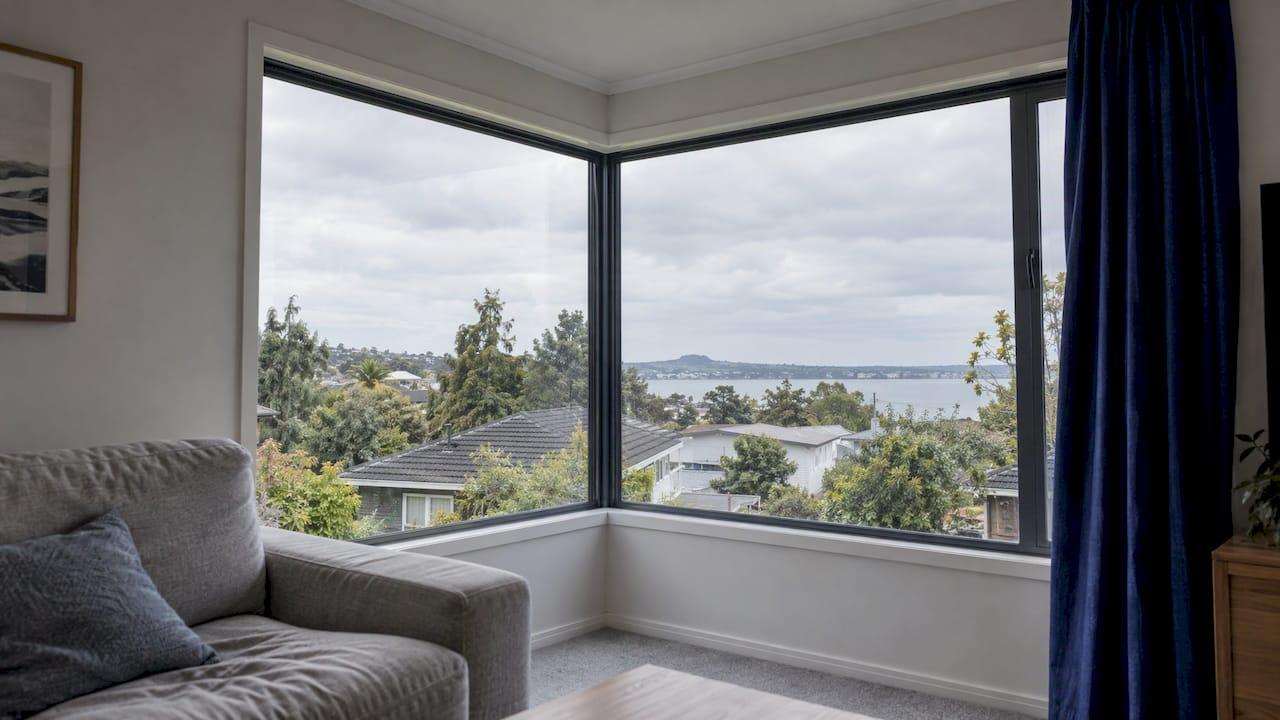
Replacing a corner window is more involved than a standard like-for-like swap, because two walls meet at that opening and the weathertightness detail, the glass and sometimes the support above all have to work together. In most older Auckland homes the job is straightforward when the opening stays the same size and in the same position. It becomes a bigger project when you want to remove a corner post or change the opening. Here is how to judge which of the two you are facing, what the rules say, and what a good installation involves.
TL;DR
- A like-for-like replacement in the same position is generally exempt from building consent, but not if the original window has failed its 15-year durability requirement. The work must still meet the Building Code.
- Corner joints are harder to flash than a flat opening, so the installation detail (sill tray, flexible tape, head flashing, air seal) matters more than the frame itself.
- If glazing area is not increased, the new window needs at least the same R-value as the old one. Replacing timber with aluminium will most likely call for double glazing.
- Removing a corner post for an uninterrupted view is a structural question. Get a designer or engineer to confirm what carries the wall or roof above before work starts.
- Cost depends mostly on size and scope, and on whether the opening is resized. We quote each job after seeing it.
Table of Contents
- What counts as a corner window
- Do you need building consent?
- What to check before you replace
- Frame and glazing options
- Insert or full replacement?
- How the replacement is done
- What affects the cost
- Comfort, safety and upkeep after replacement
- Our view: treat the corner as a junction, not just a window
- Replace your corner window with us
- FAQ
- Sources
What counts as a corner window
The term covers a few different builds, and they behave differently when it is time to replace them.
- Two framed windows meeting at a post. Each window is its own unit, sitting either side of a corner post. This is the most common arrangement in Auckland bungalows and villas, and the easiest to replace.
- Joined framed windows (mulled units). Two frames are coupled together at the corner, sometimes with a mullion between them.
- Glass-to-glass corner. Two panes meet at the corner with no post. It gives a continuous view, but the load path and maintenance conditions are different from a post-supported corner, according to guidance on corner, bay and mulled windows. That source also notes that removing a post to open up the view can affect the building's structure, and that a designer must assess what supports the wall or roof above.
Before anyone quotes, work out which of these you have, and whether you want to keep it or change it. That single answer decides most of what follows.
Do you need building consent?
For a straight replacement, usually not. Under Schedule 1 of the Building Act 2004, replacing a building product or assembly with a comparable one in the same position is exempt from consent. The exception is when the original window has not met the Building Code's 15-year durability or weathertightness requirements, as BRANZ explains. The building's structural integrity must also not be compromised.
The Licensed Building Practitioners scheme describes the same rule from the other side. Exemption 8 covers work on a window or exterior doorway in an existing dwelling or outbuilding of not more than two storeys, provided the item being replaced has not failed its 15-year durability requirement under Clause B2. A window that has rotted or leaked within 15 years of installation is therefore a consent matter. So is any work that modifies a specified system such as sprinklers or fire alarms.
Two practical points:
- Exempt does not mean unregulated. MBIE's guidance says all exempt work must still meet the Building Code, and that non-compliant work can affect insurance cover and a future sale of the property.
- Changing the opening changes the answer. Moving the window, enlarging it or removing a post is no longer a comparable replacement in the same position. MBIE recommends professional advice, from an engineer, architect, building consultant or building surveyor, for work close to or involving potentially load-bearing walls. Talk to your council before you commit to design changes.
Our guide to Building Code compliance for NZ windows and doors covers the wider picture if you want more detail.
What to check before you replace
A replacement only works if the building around the window is in good shape. The Window and Glass Association of New Zealand (WGANZ) lists what should be assessed before a replacement project goes ahead:
- the age and condition of the existing joinery;
- whether the cladding and framing can accept replacement windows, and whether they need repair first;
- the cladding type, the flashings and facings, and whether the windows are plumb, square and straight;
- wind and exposure zones;
- thermal performance, condensation control, safety, acoustics and UV fading;
- any butt-jointed panes;
- site access, including whether scaffolding or special lifting equipment is needed.
The corner deserves extra attention. The government's Settled guidance on leaky buildings notes that round and corner windows are difficult to flash, which raises the risk of water getting in, and that window flashings should be checked when weathertightness is assessed. That is not a reason to avoid a corner window. It is a reason to have the replacement installed by people who treat the junction as the main task.
If you see staining or soft timber beneath a corner sill, or swollen lining around the opening, say so when you book the measure. Damage found behind the old window is far easier to deal with before the new unit arrives than after.

Frame and glazing options
Frame material
BRANZ says replacement options are typically aluminium or uPVC. New timber or steel windows are seldom installed because of their relative cost, and fibreglass is expensive and not readily available in New Zealand (BRANZ). We work only in aluminium, so that is the system we can speak to. It suits Auckland's wet, humid and often salty conditions, and it can be made in slim profiles, which matters at a corner where you want as much glass and as little frame as possible.
For a corner that gets a lot of sun or loses a lot of heat at night, a thermally broken frame is worth discussing. We cover the details in our guides to thermally broken windows in NZ and thermal break windows and standards.
Opening style
On a corner you can mix styles. A fixed pane on one wall with an openable sash on the other gives you the view and ventilation. BRANZ points out that an upgrade is also a chance to change openable windows to fixed glass, which is cheaper and more airtight, or to reduce glazing area to limit overheating. If you want an openable section, our casement windows and sliding windows both work well beside a fixed corner pane.
Glazing and the R-value rule
This is where most replacement corner windows are decided. If the glazing area is not increased, the replacement's R-value must be at least the same as the original, and replacing timber frames with aluminium will most likely require double-glazed units to get there (BRANZ). WGANZ gives approximate values for what you are replacing: single-glazed timber around R0.15 to R0.19 depending on the frame, specifically about R0.19 for timber and R0.15 for aluminium. It also says that filling the gap between panes with argon improves an insert replacement window's performance.
If the corner glazing is part of a new build or an extension, a different rule applies. The H1 schedule method sets minimum window R-values of R0.46 for climate zones 1 to 4 and R0.50 for zones 5 and 6, and can generally be used where windows make up 30% or less of the wall area. Auckland sits in the North Island zones.

Three things shape how well a double-glazed unit performs, according to the WGANZ retro-glazing guidance: the glass type (Low-E improves performance), the spacer bar (a thermally improved spacer reduces thermal bridging) and the gas fill (argon is denser than air and improves performance further).
Safety glass
Corner windows are often low and large, which is where safety glazing rules bite. WGANZ notes that full replacement is a chance to bring glazing up to current safety requirements under F2/AS1 and NZS 4223.3:2016. Safety glass is required for panes within 800mm of the finished floor level, full-height panels, windows in bathrooms and wet areas within 2000mm of the floor, window seats within 800mm, and any unit protecting a fall of more than 1.0m (WGANZ). Safety glass can be toughened or laminated.
Insert or full replacement?
There are two ways to replace a corner window, and they suit different situations.
| Insert replacement | Full replacement | |
|---|---|---|
| What happens | New frame fits inside the existing frame or reveal | Old window removed back to the framing, new one installed |
| Disturbance to cladding and linings | Minimal | Greater |
| Best when | Existing frame and surrounding framing are sound | Frame is rotted, the junction has leaked, or you want a different size or layout |
| Opportunity to check the framing | Limited | Full access to framing and underlay |
Our pages on insert and full replacement windows and doors and our explainer on how insert window replacement works set out the trade-offs in more detail. At a corner, full replacement is often the better call where there is any sign of past water entry, because it lets you see and repair what is behind the old unit.
How the replacement is done
BRANZ describes the sequence: remove the existing window, check the framing and underlay, then install the new window. The detail that follows is what keeps the corner dry.
For direct-fixed cladding, BRANZ says flexible flashing tape should extend 100mm across the head, 100mm down each jamb and 50mm over the cladding face. Sill tape should cover the full sill width, turn up at both jambs and extend over the cladding. The same guide recommends a full-width sill tray, a continuous flexible air seal and a new head flashing if one is needed (BRANZ).
The head flashing does a specific job. WGANZ's guide to E2/AS1 Amendment 10 says its primary function is to deflect water falling or running from above away from the entry point at the head of the window, and that the vertical upstand has been increased to 65mm. It adds that the most common form is the extruded aluminium flashing, designed with a nominal 5mm gap between its back and the window face to avoid capillary action drawing water over the head (WGANZ guide).
At a corner, every one of those layers has to meet at the junction of two walls. International practice makes the same point: a key design consideration when replacing windows is keeping a continuous air and weather barrier around the perimeter of the new unit, and the drainage of both the window and the adjacent wall will dictate how the interface is waterproofed (IIBEC). Manufacturer instructions are generic, so the installer has to resolve the detail for your wall.

That is why we care about precision at the install stage. Our general approach is covered in installing aluminium windows.
What affects the cost
We do not publish set prices, because a corner window is never quite the same twice. These are the factors that move a quote the most:
- Size and scope. Larger openings cost more in total, even where the per-square-metre rate improves.
- Whether the opening stays the same. Resizing an opening or cutting a new one adds lintel and jamb framing, propping while the wall is open, and more cladding and lining to make good, compared with a straight swap.
- Post removal. If a corner post is going, expect engineering input before a price can be firm.
- Glazing specification. Double glazing, Low-E coatings, argon fill and safety glass all change the unit price.
- Frame specification. A thermally broken frame has a different cost from a standard one.
- Access. Upper-storey corners that need scaffolding or special lifting equipment cost more to reach.
- Repairs behind the window. Rotted framing or failed underlay found on removal has to be fixed before the new window goes in.
For broader context on pricing, our window replacement price guide walks through the usual variables. A site visit is the only reliable way to price a corner properly.
Comfort, safety and upkeep after replacement
BRANZ says that replacing windows with better-performing ones can significantly reduce unnecessary heat loss and the need for heating or cooling, and that going from single to double glazing can improve airtightness and acoustic insulation while reducing fading and condensation (BRANZ). Its bulletin on insulated glass units adds that, depending on design, they can also reduce sound transmission and provide increased security.
For a corner, which often faces the afternoon sun, those benefits show up as a room that is easier to sit in both winter and summer. Our guide to energy efficient windows for Auckland homes explains the choices in more depth.
Upkeep is simple. WGANZ recommends cleaning windows and glazing every three months, more often in coastal or industrial environments, using a soft brush, warm water and mild household detergent. Avoid abrasive materials and aggressive solvents (WGANZ). Much of Auckland counts as coastal, so the more frequent schedule suits many homes.
Our view: treat the corner as a junction, not just a window
We install aluminium windows and doors across Greater Auckland, and we only work in aluminium. That focus shapes how we approach corners.
A corner window is where two walls, two flashing runs and often two sets of framing meet. Most of the success of the job is decided in the first hour: reading the cladding, checking the framing, and agreeing with you whether the opening is staying as it is or changing. We would rather spend that time properly than rush to a quote.
Our approach is to match the frame and glazing to how you use the room. A thermally broken aluminium frame with double glazing is designed to give a corner the comfort a single-glazed timber window cannot, while keeping sightlines slim. We fit each unit with precision and take care to integrate modern joinery into the existing house, so the result looks like it was always meant to be there.
We back our installations with a five-year workmanship warranty, and we look after the job from the first measure to the last clean-up.
Sharim
Replace your corner window with us
If you own a home or commercial building in Greater Auckland and want a corner window replaced, we handle the supply, installation and repair of aluminium windows and doors, with single and double glazing and thermally broken frames. Whether you need an insert, a full replacement or a new layout, we will assess the opening, explain the consent position for your situation and give you a clear scope. Start with our full and insert replacement page, or contact us through the Aklwindows site.

If the glass alone has cracked and the frame is sound, our aluminium window and door repairs service may be all you need.
FAQ
Can I replace a corner window without a building consent?
Often yes. Replacing a window with a comparable one in the same position is generally exempt, provided the original has not failed its 15-year durability requirement and the building's structure is not affected. The work must still comply with the Building Code. If the window has leaked or rotted within 15 years of installation, or you plan to change the opening, check with your council first.
Can a corner post be removed to give a clear view?
It can be done, but it is a structural decision, not a window decision. The post may be carrying the wall or roof above, so a designer or engineer needs to confirm what supports the structure and how it will be replaced. Consent is likely to be needed, so speak to your council before you plan the design.
Do I need double glazing in a replacement corner window?
If you are not increasing the glazing area, the new window must have at least the same R-value as the old one. Replacing timber frames with aluminium will most likely need double-glazed units to achieve that. Low-E glass, a thermally improved spacer and argon fill can lift performance further.
Will new glass need to be safety glass?
Often, yes. Corner windows tend to be large and low, and safety glass is required for panes within 800mm of the finished floor, full-height panels, and wet-area windows within 2000mm of the floor, among other cases. Safety glass is either toughened or laminated, and we specify it according to where the pane sits.
How long does a corner window replacement take?
It depends on the type of replacement, the size of the opening and what is found behind the old window. An insert into a sound frame is quicker than a full replacement that includes repairs to the framing. We confirm the programme once we have measured and inspected the corner.
Sources
- Replacing windows in existing openings, BRANZ
- Rules for windows H1 compliance, BRANZ
- Time to change the windows, BRANZ
- Bulletin 680, insulated glass units, BRANZ
- IBP for Replacement Windows, WGANZ
- Retro-Glazing IBP, WGANZ
- Guide to E2/AS1 Amendment 10, WGANZ
- Building work that does not require a building consent, MBIE
- Know your stuff: Exempt Building Work, Part 2, Licensed Building Practitioners
- Learning about leaky buildings, Settled.govt.nz
- Bay, Bow, Corner and Mulled Windows: Support and Detailing
- Fenestration Replacement: Identifying Design Solutions for Existing Buildings, IIBEC