
You can order aluminium windows in almost any size in New Zealand. Most are made to order for the opening, so a non-standard size is normal rather than a premium extra. What matters is that the opening is measured and assessed properly, that the frame suits your wall and exposure, and that the installer follows Building Code rules. This guide explains how it works, what to check, and where homeowners go wrong.
TL;DR
- Made-to-measure aluminium windows are built to your opening, so odd sizes in older Auckland homes are routine, not a special case.
- The industry norm for installation clearance is 14 mm in total: 7 mm each side, horizontally and vertically.
- Replacing like for like in the same opening often needs no consent, but only if the original window met durability and weathertightness requirements and the new R-value is at least equal.
- Choose thermally broken frames and double glazing, because plain aluminium is a poor insulator.
- Get the opening assessed before anyone gives you a price. Flashings, cladding, framing and wind zone all affect the final window.
Table of Contents
- What custom, made-to-measure and standard sizes actually mean
- Why homeowners need custom sizes
- How to measure an opening for a made-to-measure window
- Assessment before pricing
- Building Code and consent: what applies to non-standard sizes
- How size affects performance
- What affects cost and lead time
- Our perspective
- Get a made-to-measure quote for your home
- Checklist before you sign a quote
- FAQ
- Sources
What custom, made-to-measure and standard sizes actually mean
The three phrases people search for (custom size, made to measure, non-standard) describe the same thing. The window is fabricated to dimensions taken from your opening, rather than picked from a fixed catalogue of widths and heights.
That is less exotic than it sounds in New Zealand. A 2024 Victoria University of Wellington report analysed permits for 276 houses and found highly varied window dimensions with no clear dominant sizes, although some widths appeared influenced by 0.4 m and 0.6 m stud spacings. In other words, our houses are designed one at a time, and windows follow.
Many of the top search results for this keyword come from North American sites that talk about inches and fixed catalogue sizes such as 24 x 36. That framework does not apply here. In NZ you work in millimetres, and a joiner builds the frame to suit.
Where a standard size still makes sense
The same report records industry views that standardising sizes would give limited fabrication savings and little time saving, because bespoke windows can be manufactured to order. It also flags risks such as over-specification and reduced design flexibility. So choosing a "common" size to save money is rarely the lever people assume. Fit, glass specification and installation complexity move the price far more.
There is one good reason to keep a size the same: matching the existing openings. If you keep the original opening, there is no framing alteration and less making good inside and out.
Why homeowners need custom sizes
The typical situations we see across Greater Auckland:
- Older villas and bungalows where timber openings have moved over decades, so no two windows are quite the same.
- Renovations where the opening is being enlarged for a sliding door, bifold or a wider picture window.
- Replacing timber with aluminium in a hole that was never a modern standard size.
- Brick or masonry houses where the opening cannot easily be altered. Our guide to replacing windows in a brick house covers that case.
- Heritage character homes where sightlines and proportions matter. See our historic home window replacement guide.
How to measure an opening for a made-to-measure window
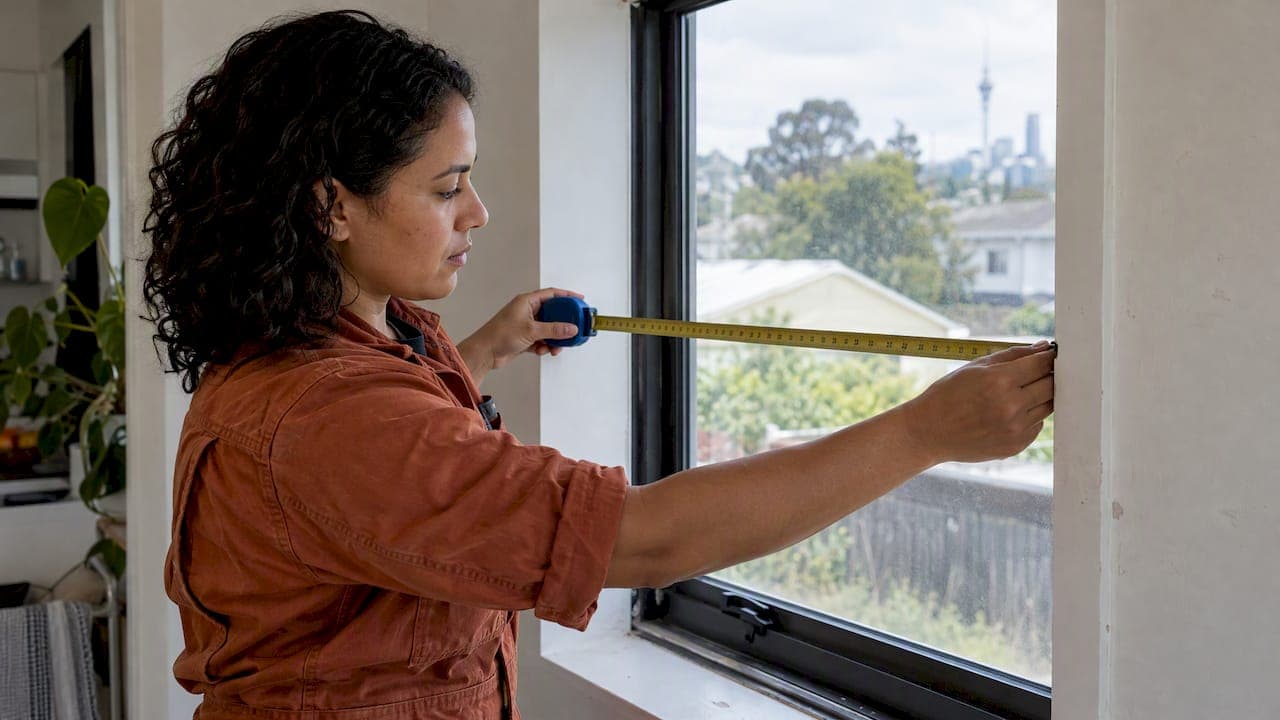
You should not rely on your own tape measure to order. A professional measure and assessment is part of getting a window that fits and stays weathertight. Still, understanding the process helps you check a quote.
Step by step
- Measure the opening, not the old window. The old frame may have been packed, trimmed or altered. Measure the actual hole once the frame is out, or the reveal dimensions if you are inserting.
- Take width and height in three places. Measure top, middle and bottom for width, and left, centre and right for height. Openings are rarely square, so the smallest figure governs.
- Check squareness. Measure both diagonals. A difference means the frame needs to be built or packed to suit.
- Allow for installation clearance. The Window & Glass Association's technical advice states that normal NZ industry practice is 14 mm total clearance, 7 mm per side, horizontally and vertically. It also advises agreeing any alternative with the supplier and building designer before manufacture. The window is built smaller than the opening by that margin, which leaves room for flashing tapes, sealant and levelling.
- Record the sill, head and jamb details. Flashings, cladding type and reveal depth decide how the frame sits in the wall.
- Note the window opening style. Sliding, awning, casement or fixed all have different frame depths and sash allowances.
A common mistake is ordering to the exact opening size with no clearance. The window then cannot be fitted, or it is forced in and the seals fail.
Insert versus full replacement
There are two ways to install a new frame. An insert fits the new aluminium unit inside the existing frame or reveal, which keeps disruption low. A full replacement removes the old frame back to the framing, which allows inspection, new flashings and a change in size. Either way, the order dimensions come from what is actually there. Our insert and full replacement service page explains how we choose between them. For the installation process itself, see installing aluminium windows.

Assessment before pricing
The Window & Glass Association's replacement-window best-practice document says a project should be assessed before it is priced, because not every existing window is suitable for full replacement. The assessment looks at cladding and framing, wind and exposure zones, flashings, the condition of what is there, the thermal or safety outcome you want, and whether consent may be needed.
It is worth asking any installer what their assessment covers. A quote given from a phone photo, or a price per square metre with no site visit, skips the checks that decide whether the window will perform. The same guidance indicates that fit, weathertightness and performance depend on verified site conditions, not only on the window itself.
Building Code and consent: what applies to non-standard sizes
Size alone does not trigger anything. What matters is whether you are replacing like for like or changing the opening.
Replacing in the same opening
BRANZ explains that replacement work must meet Building Code performance requirements and must not compromise structural integrity. A comparable product may be used without consent in the same position, with an exception: if the original window has not met the 15-year durability or weathertightness requirements, that route is closed. If the glazing area is not increased, the replacement window's R-value must be at least the same as the original.
That last point is good news for most people, because modern double-glazed thermally broken units usually outperform old single-glazed frames comfortably.
Enlarging or moving an opening
If you cut a bigger opening, you may be altering structure, bracing or lintels. That is a different job from a swap and usually involves a building consent and sometimes an engineer. Check with your local council or a licensed building practitioner before you commit to a larger size. Our building code compliance guide walks through the typical triggers.
Closing and ventilation
The current Acceptable Solution H1/AS1 (sixth edition, effective 27 November 2025) states that windows, doors and vents allowing significant air movement in housing must be capable of being fixed in the closed position. Practically, your custom window needs hardware that seals properly when shut.
Evidence of suitability
Windows & Glass NZ says compliance with NZS 4211, which tests for air leakage, water leakage and wind resistance, is evidence a window unit is suitable for NZ conditions. Ask your supplier for test evidence for the actual series you are buying. Custom sizes are normally built from tested systems within allowable size ranges.
How size affects performance
Weathertightness and support
In cavity-wall installations, BRANZ says a sill support bar is required for windows and doors over 600 mm wide, and it must allow water to drain and air to pass. So as a window gets wider, installation detail matters more, not less.

Older homes add another risk. Many with direct-fixed cladding lack wall underlay around the opening, and BRANZ advises that framing should be inspected for soundness once the old window is removed. If rot is found, the opening may need repair before the new frame goes in, which affects both the programme and the cost.
Insulation
Aluminium conducts heat readily. Building Performance, part of MBIE, notes that aluminium is a poor insulator and that owners should consider thermal breaks or combining aluminium with other materials. A thermal break is a barrier inside the frame that interrupts the heat path. Our guides on thermal break windows and thermally broken window costs and standards go deeper.
BRANZ-linked research recommends that when windows are repaired or replaced, the specification be raised: double glazing, low-emissivity or argon-filled glass, and thermally broken aluminium frames. Beacon Pathway's work also describes how double glazing reduces heat loss and condensation, which protects internal finishes. For a broader view, read our energy efficient windows guide.
Glass area matters too. A very large custom pane gives more daylight and view, but more heat loss and solar gain through glass, so specification becomes more important as you go bigger.
Ventilation
Aluminium frames can be designed with integrated passive ventilation so air keeps circulating even when windows are closed. If you are shrinking or enlarging openings, think about where your trickle or opening vents will sit.
Durability
BRANZ notes that windows are among the most carbon-intensive elements of a new house because of the embodied carbon in aluminium and glass. That is a reason to buy once and buy well: a precisely made frame with good finish and hardware that lasts decades beats a cheap one replaced in fifteen years.
What affects cost and lead time
We do not publish fixed prices because every opening is different, and we would rather quote after seeing yours. These are the factors that move a custom window quote:
| Factor | Why it matters |
|---|---|
| Size and glass weight | Larger panes need heavier glass, stronger reinforcement and sometimes lifting equipment |
| Frame series and thermal break | Thermally broken systems cost more than standard frames but perform better |
| Glazing specification | Double glazing, low-E coatings, argon fill and safety glass add cost |
| Opening style | Fixed panes are simpler than sliding, awning or bifold arrangements |
| Insert or full replacement | Full replacement involves cladding work, new flashings and making good |
| Condition of framing | Rot or missing underlay found on removal adds repair work |
| Access and storeys | Upper floors and tight sites take more labour |
| Consent needs | Altered openings add design and approval time |
Because windows are made to order, lead time depends on fabrication scheduling and glass supply rather than on whether your size is "standard". The Victoria University report makes the same point: bespoke windows are made to order, so using common sizes would not necessarily speed a project. Ask for the current lead time in writing when you accept a quote. For ballpark budgets, our window replacement price guide is the place to start.
Our perspective
We work only in aluminium joinery, and that focus shapes how we handle custom sizes. In our experience the size itself is rarely the problem. The problems come from an opening that was never checked: a rotted sill, a wall that is out of square, a flashing detail nobody looked at.
So we measure on site, look at the cladding and framing, and talk through glazing and thermal break options before we talk about a price. We would rather lose a job by saying an opening needs repair first than install a beautiful window into a wet wall.
For most Auckland homes we suggest thermally broken frames with double glazing. Auckland's damp, salty and humid climate punishes poor seals and weak finishes, and a tight, precisely fitted frame is what keeps draughts out and condensation down. We back our installation with a five-year workmanship warranty, because fit is the part we control.
— Sharim
Get a made-to-measure quote for your home
We supply and install made-to-measure aluminium windows and doors across Greater Auckland, for homes and commercial buildings. That includes sliding windows, sliding doors, bifold doors, French doors and entry doors, in single or double glazing. Tell us about your opening and we will arrange a site measure.

Start on our aluminium windows page to see the range, or go straight to full replacement and insert options. For existing frames that are sticking, leaking or worn, our repair service may save you replacing them. Commercial owners can look at shopfronts and commercial doors.
Checklist before you sign a quote
- Has someone visited and assessed the opening, cladding and framing?
- Does the quote state dimensions in millimetres, and the clearance allowed?
- Is the frame thermally broken, and what is the glazing specification?
- Can the supplier show test evidence against NZS 4211 for the system?
- Is consent needed, and who is responsible for it?
- What happens if rot or damage is found on removal?
- Is the lead time written down?
- What warranty covers the workmanship, and for how long?
For a wider look at materials and frame options, our homeowner's guide to aluminium windows and frames and the 2026 guide to aluminium doors and windows for Auckland homes are useful companions.
FAQ
Can I get windows made in any size?
In most cases, yes. Aluminium windows are fabricated to order, so the size follows your opening within the limits of the frame system and glass. Very large panes may need heavier glass, extra reinforcement or support, and openings that are enlarged may need consent.
Do custom-size windows cost much more than standard ones?
Not necessarily. In New Zealand most windows are made to order anyway, and local industry views recorded in a 2024 report suggest standardising would give limited fabrication savings. Glass specification, frame type and installation work usually affect price more than the dimensions.
Do I need a building consent to replace windows with a different size?
Swapping a comparable window in the same position often needs no consent, provided the original met durability and weathertightness requirements. Making the opening bigger or changing structure is different and may need consent. Check with your council or a licensed building practitioner before work starts.
How much clearance should there be around a made-to-measure window?
Normal NZ industry practice is 14 mm in total, which is 7 mm each side, horizontally and vertically. Your installer and building designer can agree a different allowance before manufacture, but it should be decided before the window is made.
Should I choose thermally broken aluminium?
For most homes, yes. Aluminium is a poor insulator on its own, and the government's Building Performance guidance suggests thermal breaks or combining materials. Paired with double glazing, a thermally broken frame helps reduce heat loss and condensation.
Sources
- Window Standardisation: The Potential in New Zealand (Victoria University of Wellington, 2024)
- Technical FAQ (Window Association of New Zealand)
- Industry best practice for replacement windows (Window & Glass Association NZ, 2024)
- Replacing windows in existing openings (BRANZ)
- Acceptable Solution H1/AS1 Energy efficiency, sixth edition (Building Performance)
- Windows and Glazed Doors guide (Windows & Glass NZ)
- Drained cavity window installation (BRANZ)
- Window and door frames (Building Performance)
- Halswell 1 case study report (Beacon Pathway)
- A case study in home performance (Beacon Pathway)
- BRANZ study report on benchmarking new homes (Beacon Pathway)