
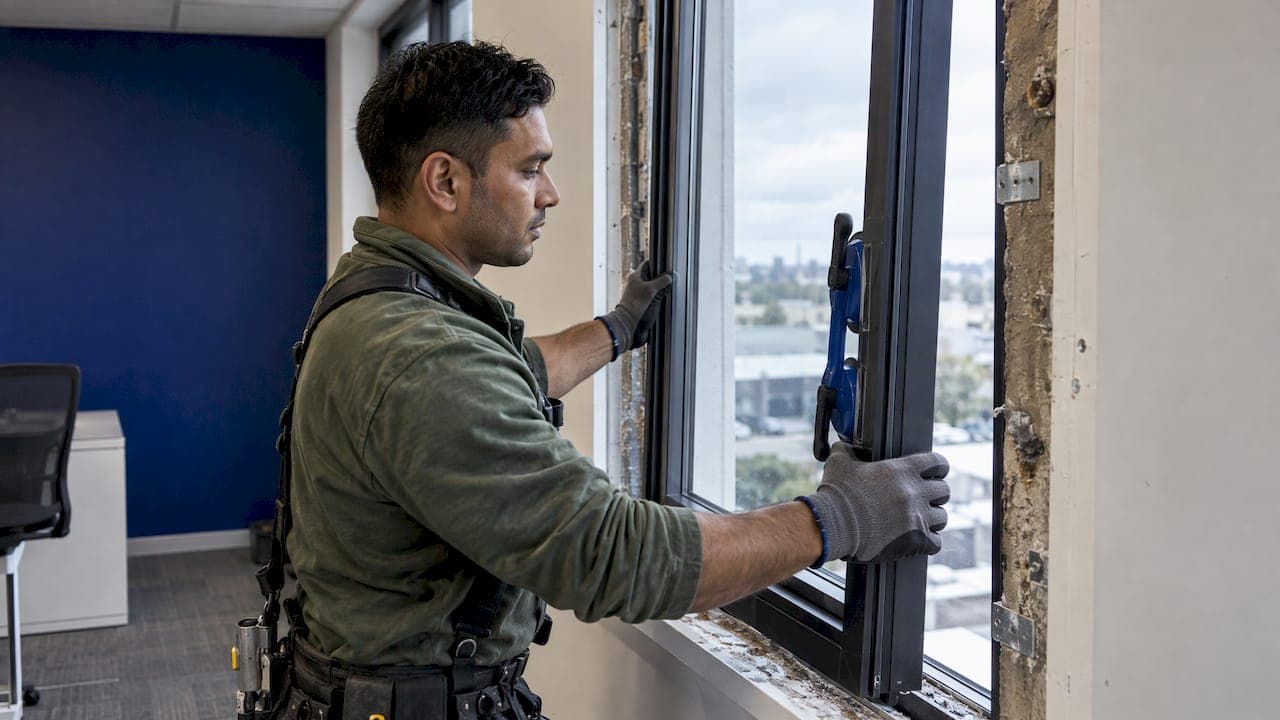
Office window replacement means removing the old windows and fitting new ones, or, where the frames are sound, swapping only the glass inside them. For most Auckland offices with draughty, noisy or tired aluminium or timber joinery, a full or insert replacement in thermally broken aluminium with double glazing is the route that fixes comfort and appearance together. This guide explains how to choose between the options, what the Building Code expects, and how to get the job done with as little disruption to your team as possible.
TL;DR
- Replacement removes the old windows and installs new ones. Retrofit glazing only replaces the glass in the existing frames. Which one suits you depends on the condition of the frames.
- Thermally broken aluminium with double glazing is the usual upgrade for comfort, noise and energy performance in Auckland offices.
- Safety glass, NZS 4211 labelling and Building Code compliance apply to the work. Check consent with your building consent authority before you start, because the common exemption is written for dwellings.
- A typical installation takes a couple of days, and good planning keeps the office running while it happens.
- We supply and install aluminium windows and doors across Greater Auckland, with a five-year workmanship warranty.
Table of Contents
- Replacement, retrofit or repair: which one does your office need?
- Why offices benefit from new windows
- Frames: aluminium, thermally broken aluminium or uPVC
- Glazing choices that suit an office
- Building Code and consent: what to check first
- Can you replace office glass yourself?
- What the installation looks like
- Perspective
- Our office window and door service
- What drives the cost
- Choosing an installer
- FAQ
- Sources
Replacement, retrofit or repair: which one does your office need?
Three different jobs get lumped together under "window replacement", and the right one saves you money and downtime.
Full replacement removes the existing windows and installs brand-new ones. Windows & Glass NZ describes this as the option often chosen when upgrading from timber to aluminium or other newer materials.
Retrofit glazing replaces the glass in the existing frames without removing the frames. It suits frames that are straight, sound and still operate well.
Repair deals with a failed part: a worn seal, a stiff sash, a broken latch or a damaged hinge. Window components can fail independently, so one faulty part does not automatically mean the whole unit has to go.
A simple way to decide:
| Situation | Usual direction |
|---|---|
| Frames sound, glass cracked, fogged or single-glazed | Glass replacement or retrofit |
| Frames corroded, warped, leaking or hard to operate | Full or insert replacement |
| One hardware part failing, rest in good order | Repair |
| Dated look, draughts and noise throughout | Full replacement with modern frames |
BRANZ notes that when a frame is significantly damaged or rotted, replacement is often more cost-effective than extensive repairs. That is the point where patching stops making sense.
Full replacement or insert?
A full replacement takes out the old frames and, where needed, the surrounding linings, so the new window sits in a freshly prepared opening. An insert installs a new aluminium window within the existing frame or opening, which can mean less disturbance to interior finishes. We install both, and the right one comes down to what we find at the opening. You can read how this works in our guide to insert window replacement, or see our full replacement and insert service.

Why offices benefit from new windows
Office windows work hard. They face long daily use, glare on screens, street noise and temperature swings between a sunny morning and a cold evening. Old single-glazed units often leave staff sitting near cold glass in winter and hot glass in summer.
BRANZ experts point out that windows can account for up to 40% of heat losses in buildings built to minimum code requirements. Better glazing and better frames reach straight to that loss.
The practical gains for an office are:
- Comfort at desks: fewer cold spots and draughts near the perimeter.
- Quieter rooms: laminated glass and double glazing help with traffic and neighbouring activity.
- A tidier frontage: modern slim aluminium profiles lift how the building looks to clients.
- Security and function: reliable locks and smooth operation.
Frames: aluminium, thermally broken aluminium or uPVC
The replacement frame guidance from Windows & Glass NZ covers aluminium, thermally broken aluminium and uPVC replacement frames. It does not cover replacement timber joinery.
We work only in aluminium, and for good reason in an office setting. Aluminium is strong enough for large panes and wide spans, holds slim sightlines, and copes with Auckland's sun, salt air and wind. Windows and glazed doors are used heavily every day, and WGANZ stresses that they should be selected for durability against local site conditions such as wind and sun exposure.
Why thermal breaks matter
Plain aluminium conducts heat readily. A thermal break is a plastic element between the aluminium frame parts that interrupts heat transfer and improves the frame's R-value. For a work area that is heated and cooled all day, that means steadier temperatures and less condensation on frames. We cover costs and standards in detail in our guides to thermally broken windows in NZ and thermal break windows.
A word on uPVC
uPVC is common in Europe and North America. WGANZ notes that fitting it into New Zealand buildings has to account for local construction methods, and that it often needs steel reinforcement to meet wind load requirements. Large office openings are one place where aluminium's strength is a real advantage.
Glazing choices that suit an office
The glass matters as much as the frame. MBIE's Building Performance guidance lists Low-E coatings, tinted, reflective, laminated and toughened glass as options for controlling light transmission, heat gain, noise and safety.
| Glass type | What it does in an office |
|---|---|
| Low-E coated | Reduces heat loss and unwanted heat gain |
| Tinted or reflective | Cuts glare and solar heat on sunny elevations |
| Laminated | Adds noise reduction and holds together if broken |
| Toughened | Safety glass for doors, low panes and areas people may contact |
Double glazing
Insulated glass units (IGUs) are two panes with a sealed gap. Under the H1/AS1 fifth-edition Schedule method, IGUs are required in housing and buildings up to 300 m², and argon-filled units reduce window heat loss by around 3 to 9% compared with air-filled units. BRANZ expects IGUs to last at least 15 years, though how long they last depends heavily on specification for the location, quality of installation and maintenance.
One point for retrofit jobs: a 16 mm unit, made of two 4 mm panes with an 8 mm gap, is common in timber sashes, but it must be properly supported on setting blocks. Whether an existing frame can take a thicker double-glazed unit is something we check on site before recommending a glass-only upgrade.

Safety glass
Glass that people are likely to touch or fall against must break safely, resist impact or be protected by a barrier. Building Code clause F2.3.3 requires that, and the glass must carry a stamp showing it is safety glass meeting the required standard. Safety glass is permanently marked with the manufacturer's name, type (T for toughened, for example), the testing standard such as AS/NZS 2208 and its impact classification. In an office, think of glazed doors, full-height panels, side lights and low windows near walkways.
Building Code and consent: what to check first
This is the area where offices differ from houses, so read it carefully.
MBIE's exemption guidance says window work in an existing dwelling or outbuilding of no more than two storeys usually does not need building consent, as long as the window has not failed prematurely and the work does not affect a specified system. That wording is about dwellings and outbuildings. For a commercial office, confirm the position with the Auckland Council building consent team or your designer before you order anything, particularly for multi-storey buildings, shopfronts and any work touching structure, fire or access systems.
Whatever the consent answer, all new work must comply with the Building Code, including its structural requirements. A few points hold across the board:
- BRANZ says the exemption applies where a comparable product is used in the same position, and it does not apply if the original window failed to meet the Building Code's 15-year durability requirements.
- Repairs or replacements of a small part of the envelope should make sure the overall thermal resistance is not diminished. Swapping an old wood-framed window for an aluminium one of the same size can be offset with extra insulation elsewhere. A thermally broken frame with double glazing helps here.
- New windows should be tested for air leakage, water leakage and wind resistance and should display an NZS 4211 label as proof of compliance.
Our overview of Building Code compliance for NZ windows and doors goes into more detail.
If you lease your office, get your landlord's or body corporate's written approval before work begins. Windows are usually part of the building's exterior, and approvals are often needed for changes to the facade.
Can you replace office glass yourself?
For a commercial building, we would say no, and for good reason. Glass is heavy, large panes are hard to handle safely, and the replacement has to meet Building Code safety-glass and weathertightness requirements. Installation quality also drives how long double glazing lasts, and BRANZ lists high-quality installation among the factors that decide whether an IGU reaches its expected life. For a business, there is also the matter of insurance and a workmanship warranty, which a trained installer provides. Ask a qualified aluminium joinery installer to scope and fit the work.
What the installation looks like
Consumer NZ says window replacement installation typically takes a couple of days. Installers cut around the old windows, fit the new ones, then install architraves indoors to cover the edges, with painting on the frames inside and out where needed and new flashings sometimes included.
For an office, that sequence needs a plan. Here is how we suggest approaching it.
- Measure and specify. Confirm opening sizes, glass type, safety glass locations and opening styles for each elevation.
- Stage the work. Do one floor, one elevation or one zone at a time so staff can move rather than stop.
- Protect the workspace. Clear desks and IT equipment from the window zone and cover floors.
- Schedule smartly. Noisy cutting and removal often suits early mornings, weekends or quieter periods.
- Finish and handover. Check operation, locks, seals, safety-glass stamps and interior finishing before sign-off.
Once the new glass is in, consider how you will manage light and privacy. Wide office openings can be tricky, and large window blinds are one way to handle glare and privacy on big spans.
Perspective
We only work in aluminium joinery, and that focus shapes how we approach office windows. When a client calls about draughts, noise or a tired frontage, we start by looking at the existing frames, because that decides whether a glass upgrade, an insert or a full replacement is right.
Our view is that most offices with ageing joinery get the best long-term result from a properly specified thermally broken aluminium frame with double glazing, installed precisely. Auckland's wind, sun and salt air are tough on windows, and precision at the opening is what makes a unit perform as designed.
That is why we put so much weight on installation and aftercare. Our work is backed by a five-year workmanship warranty, and we aim to be the single point of contact from first measure to final handover.
Sharim
Our office window and door service
We supply and install premium aluminium windows and doors across Greater Auckland, for homes and commercial properties. For offices, that includes aluminium windows, sliding and French doors, entry doors, and commercial doors and shopfronts, with single and double glazing and thermally broken frames. We also handle aluminium window and door repairs when a full replacement is not needed.

Tell us about your building, the number of openings and how many floors are involved, and we will recommend replacement, insert or repair and plan the install around your working hours. Start from our full replacement and insert page.
What drives the cost
We do not publish set prices, because every office is different. The main factors are:
- Number and size of openings. Large panes and full-height glazing cost more than standard windows.
- Frame type. Thermally broken aluminium costs more than standard aluminium and delivers better thermal performance.
- Glass specification. Low-E, laminated, tinted and toughened glass each change the price.
- Replacement or insert. The condition of existing frames and linings affects the amount of making good.
- Access. Upper floors and tight access add time.
- Finishing. Interior linings, architraves and painting.
For general background, see our window replacement price guide for NZ and our guide to energy efficient windows. For a firm figure, request a quote based on your actual openings.
Choosing an installer
A good commercial window installer should be able to answer these questions clearly:
- Will the windows carry an NZS 4211 label?
- Which panes need safety glass, and how will it be marked?
- Is the work covered by a workmanship warranty, and for how long? Ours is five years.
- How will the work be staged to keep your team working?
- Who handles consent questions, and who is your contact throughout?
If you want to understand the product itself first, our guide to aluminium windows and frames and 2026 guide to aluminium doors and windows explain the basics.
FAQ
How long does office window replacement take?
Consumer NZ says the installation for a window replacement typically takes a couple of days. Larger offices with many openings take longer, so we stage the work floor by floor or elevation by elevation. We confirm the programme once we have measured.
Do I need a building consent to replace office windows?
The MBIE exemption for like-for-like window work is written for existing dwellings and outbuildings of up to two storeys. For an office, check with your building consent authority before work starts. Either way, the new windows must comply with the Building Code.
Can I keep my frames and just replace the glass?
Often yes, if the frames are straight, sound and operate well. That is called retrofit glazing. If the frames are corroded, warped or leaking, replacing them gives a better result than re-glazing them.
Is double glazing worth it for an office?
Double glazing uses a sealed gap between two panes to cut heat loss and noise, and argon-filled units reduce heat loss further than air-filled ones. Combined with a thermally broken aluminium frame, it makes work areas near windows more comfortable.
Sources
- Upgrading Your Existing Windows, Windows & Glass NZ
- Replacing windows in existing openings, BRANZ
- Passive design for glazing systems and units, Level
- Replacement windows guide, Windows & Glass NZ
- Windows and Glazed Doors, Windows & Glass NZ
- Choosing Frame Materials, Windows & Glass NZ
- Glazing and glass options, Building Performance
- IGU Bulletin, BRANZ
- Looking into timber windows, BRANZ
- Making sure you have safety glass, Building Performance
- Windows and exterior doorways in existing dwellings and outbuildings, Building Performance
- Repairs and replacements, H1 compliance
- Replacing your windows, Consumer NZ
- Large window blinds